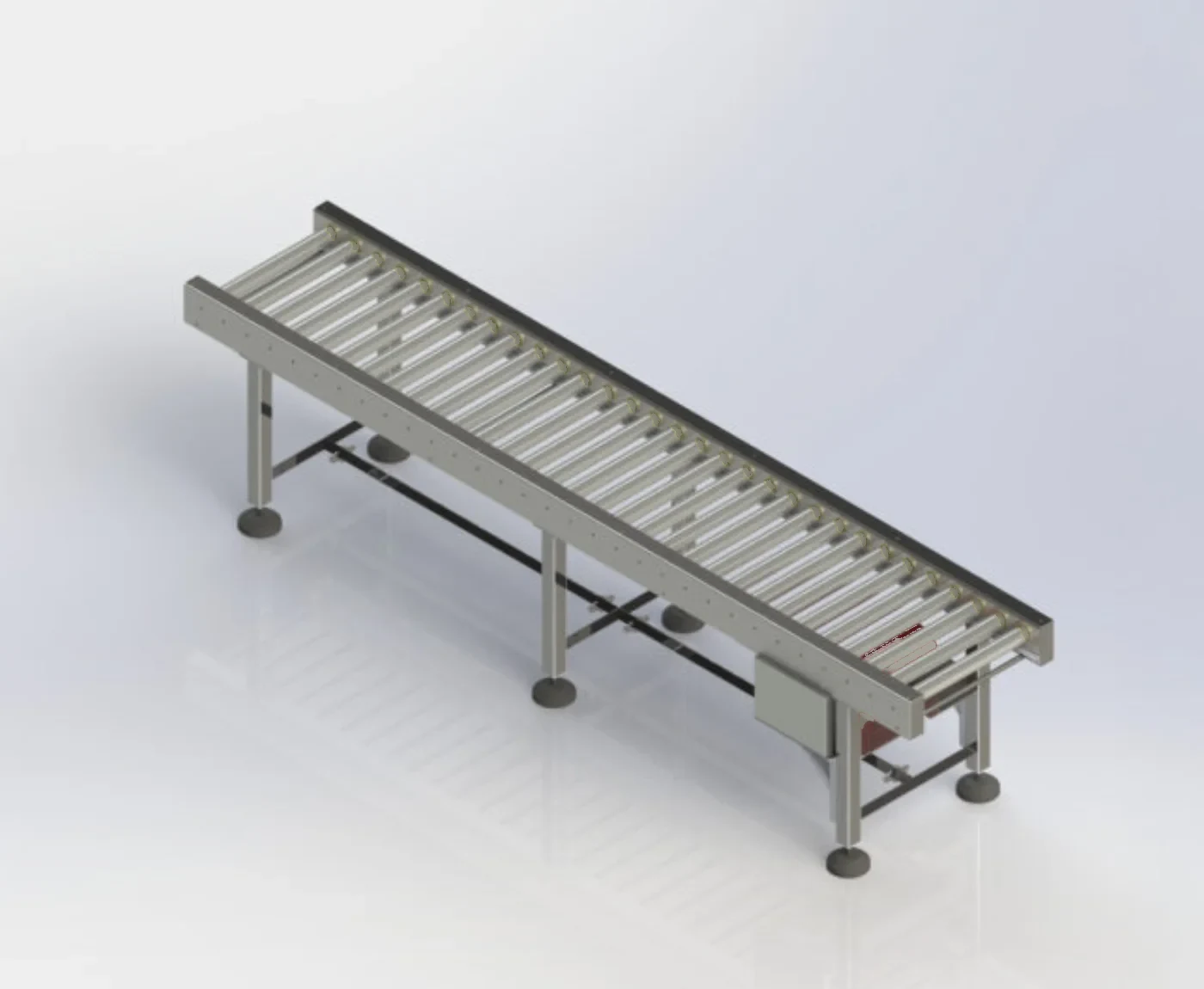
KFT-15 · Roller Series

Power Roller

Driven rollers for controlled transport of unit loads.

Driven rollers that move unit loads at a set speed and hold them when the machine downstream is not ready.

  • Family Roller
  • Series Roller Series
  • Type code KFT-15
  • Configuration Roller deck
  • Construction SS 304 / MS
Anatomy · SSE-1759

Inside the power roller

Scroll to walk the assembly. Each step picks out the parts it describes in colour and leaves the rest in plain steel.

01

Two drive stations

Two shaft-mounted gear units sit under the bed at 975 mm centres rather than one at the end. Splitting the drive is what lets the two halves of the bed run independently — the basis of accumulation, where one zone holds product while the next keeps moving. Each unit turns a 14-tooth sprocket onto BS 08B ½in chain, which runs roller to roller inside the side frame.

Gear unit
AS 16 · P12.47 · IEC 71 B5
Stations
Two, at 975 mm centres
02

Sprocket roller deck

Twenty-eight Ø62 rollers on an 89 mm pitch make up the carrying surface. Each one carries a duplex sprocket: one row of teeth takes drive from the roller behind it and the second passes it on to the roller ahead, so a single chain run powers the whole bed.

Rollers
28 × Ø62, 683 mm face
Pitch
89 mm
03

Zone sensing

Retro-reflective sensors look across the width to a reflector on the far frame, so a pack breaking the beam tells the controller a zone is occupied. That signal is what stops the zone behind it and turns a driven bed into an accumulating one.

Sensors
SICK WL100, three positions
Target
P250 reflector, opposite frame
04

Side frames

Two 2.5 m folded channels carry every roller shaft and hide the chain run inside their depth. Roller pitch is set by the hole line punched into them, so spacing is fixed at fabrication rather than adjusted on assembly.

Length
2.5 m
Between frames
683 mm
05

Legs & levelling

Three pairs of 50 × 50 legs, cross-braced and gusseted, stand the bed at roughly 795 mm overall. M16 levelling pads at each foot true the deck on an uneven floor — important on a roller bed, where a twist in the frame shows up immediately as product drifting to one side.

Legs
6 × 50 × 50, braced
Feet
M16 levelling pads
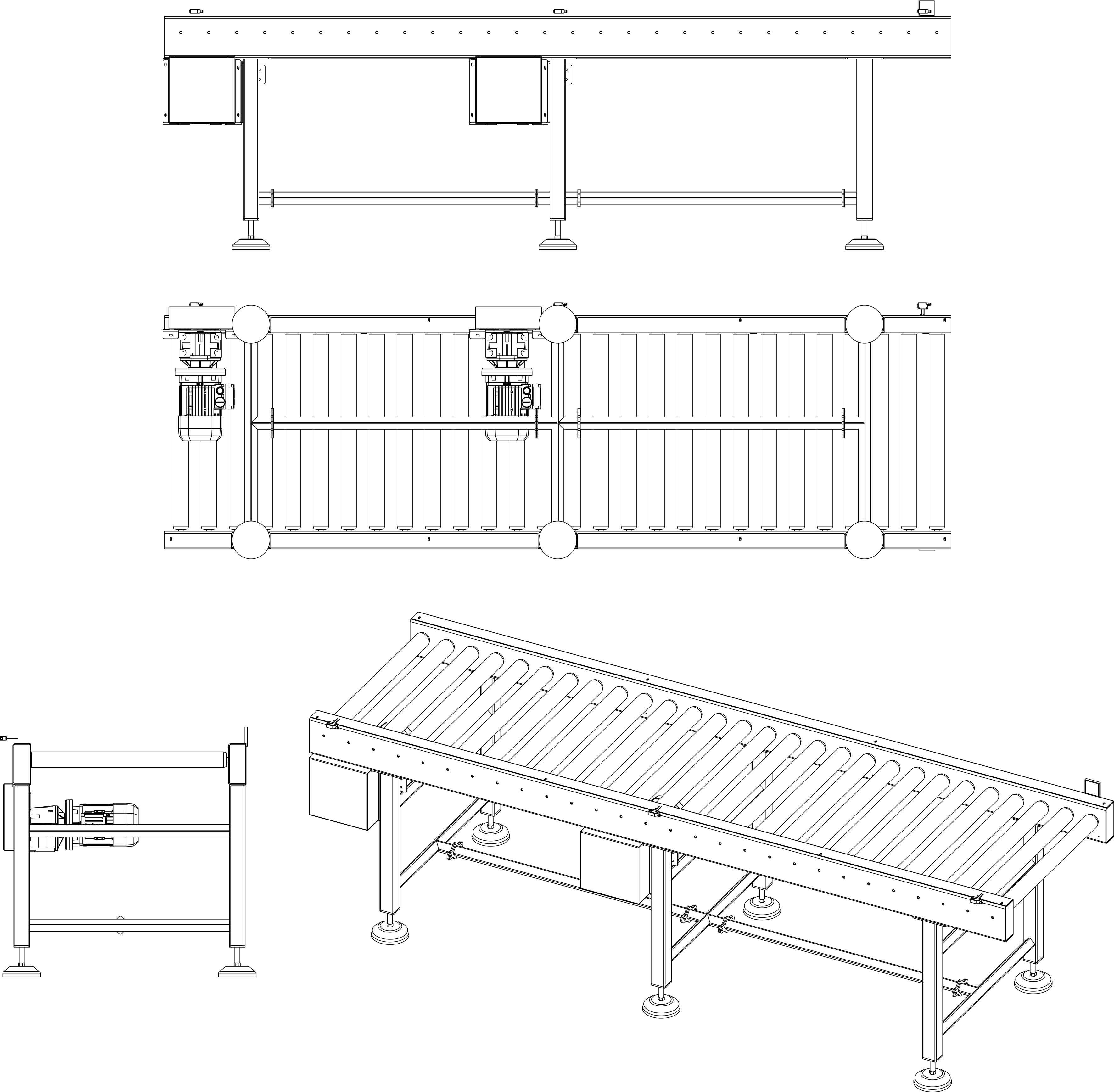
General arrangement

Drawing SSE-1759

Elevations, plan and isometric from the production GA sheet — the same drawing the machine is built from.

General arrangement drawing SSE-1759 — elevations, plan and isometric views of the Power Roller
Features

What is built into it

  • Powered roller system with adjustable speed capability

  • Modular and compact construction design

  • Minimal maintenance requirements

  • Bi-directional operational capability

  • High operational efficiency with labor-saving automation

  • Flexible layout configurations

  • Reliable and consistent speed performance

  • Multiple roller drive options: Sprocket / Belt / Cord / Grooved Driven

Specification

Standard ranges

An envelope, not a fixed configuration — every dimension is set on the GA drawing.

Power Roller — general arrangement sheet SSE-1759, converted from the works DXF: elevations, plan and isometric to a common scale
Length
0.5-10 Mtr (customizable)
Width
300-1000 mm
Height
700-900 mm (customizable)
MOC (Material of Construction)
SS 304 / MS
Roller Diameter
38-60 mm
Speed
3-20 m/min
Voltage
220 V / 415 V
Drive Type
Direct / Chain / Belt
Roller Type
Sprocket / Belt / Cord / Grooved Driven
Motor Position
Right / Left / Center
Surface Finish
SS Matt Finish / Bead Blast; MS Painting & Powder Coating
Support System
Levelling Pads / Wheel
Applications

Where it runs

  • Airports
  • Assembly lines
  • Automobiles
  • Cosmetics
  • E-commerce
  • Electronics
  • Food and beverages
  • Manufacturing
  • Packaging
  • Pharmaceuticals
  • Warehousing
  • Waste management
  • Boxes and tray transportation
  • Bottle capping and vaccine/blister pack handling
  • Grain, nuts, snacks and biscuits handling
  • Sheet metal parts handling
Enquire

Specify this conveyor to your line.

Send the product, the rate and the floor plan. We come back with a layout, a full specification and a price — normally within five working days.